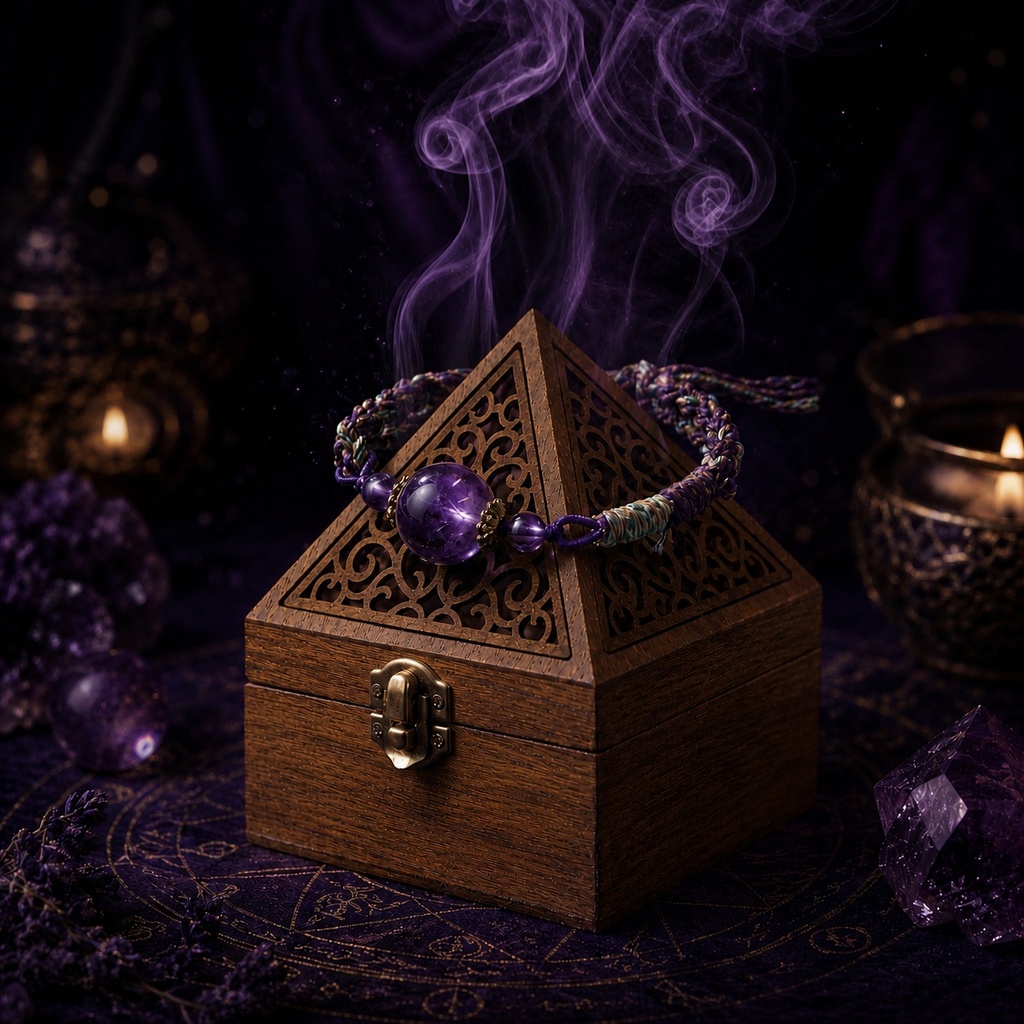
There’s a small moment that happens with handmade things and almost never happens with factory-made ones. You turn the piece over in your palm and notice something: a knot tied slightly off-center, a stone that leans warmer or cooler than it looked online, a cord that has already softened where someone’s fingers pulled it tight. Nothing is wrong. That’s actually the whole point.
Handcrafted jewelry carries the trace of a person’s hands. Not in a dramatic, heirloom way, but in a quiet, everyday way. A bracelet sits a little differently on your wrist because it was knotted rather than stamped. A pendant hangs a few degrees off true because someone adjusted it by eye. These are the details that make a piece feel less like a product and more like an object with a history, even if that history is only a few weeks old.
This is why handcrafted jewelry keeps coming up in conversations about personal style, slow living, and small daily rituals. It isn’t only about how a piece looks. It’s about how it feels to wear something that was never duplicated ten thousand times over.
What Changes When a Person, Not a Machine, Makes the Piece
Mass-produced jewelry is designed for consistency. The goal is that every unit looks identical, which is efficient and, for a lot of purposes, completely fine. But consistency has a side effect: it removes the small decisions. Every curve is pre-approved, every color is matched to a swatch, every length is cut to the millimeter by a machine that never gets tired or distracted.
Handcrafted work is the opposite. It’s full of small decisions, made one at a time, by someone who is paying attention. Which stone goes next to which. How tightly to pull a knot. Where to place the clasp so it doesn’t dig into the wrist. Those decisions don’t show up as flaws. They show up as character, and you can feel them before you can explain them.
The small irregularities you can feel with your fingertips
Run your thumb along a handwoven bracelet and you’ll notice a rhythm that isn’t perfectly even. Some knots sit closer together than others. The tension shifts slightly. That texture is a signature, and it’s one of the reasons handwoven bracelets feel different from molded or machine-linked ones. Your skin registers the difference long before your eyes do.
This is also why two bracelets from the same design can feel like siblings rather than twins. A piece like Return to Zero is knotted by hand, so the weave has its own small personality. Nobody else’s version of it will feel exactly the way yours does against your wrist.
Shop the Sorvara ritual
Braided Cords, Knots, and the Trace of a Human Hand
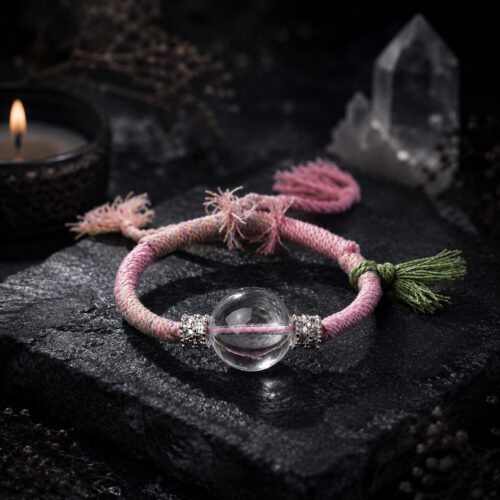
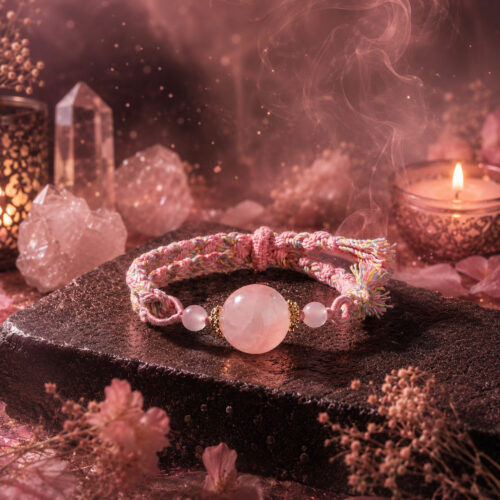
Cord work is where handmade jewelry becomes almost confessional. Braiding and knotting are slow, repetitive, tactile crafts. You can’t rush them without the finished piece looking rushed. The person making it sits with the cord for a while, and that time gets stored in the object.
There’s also something deeply familiar about cord. Long before metal chains, people wore braided fiber, leather, and thread. A knotted cord is one of the oldest forms of adornment there is, which may be why a handwoven bracelet can feel grounding in a way that a stiff bangle never quite does. It moves with you. It softens. It takes on the shape of your wrist over weeks and months.
Designs that lean into cord work, like Violet Heart or Rose Memory, tend to develop a worn-in quality that feels earned rather than purchased. The cord relaxes. The color settles. The piece starts to look like it belongs to you, because in a small way, it now does.
Natural Stone Variation: Why Your Stone Won’t Look Exactly Like the Photo
If you’ve ever ordered a crystal bracelet and been surprised by the exact shade that arrived, you’ve met natural stone variation. It’s the reason no two pieces are truly identical, and it’s one of the most honest things about crystal jewelry.
Stones are formed by geology, not by a color-matching department. Heat, pressure, and mineral content decide what a stone looks like, and those conditions are never perfectly repeated. So a clear quartz may carry a faint cloudiness in one piece and read almost glassy in another. An amethyst-inspired purple can lean lilac, or smoky, or deep violet. Rose quartz often drifts between pale pink and a warmer blush.
In mass production, this variation gets minimized or dyed away. In small-batch work, it gets celebrated, because the maker is choosing stones by eye and pairing them with intention rather than matching them to a Pantone number.
How to read natural variation like a feature, not a flaw
- Treat inclusions as fingerprints. Small internal patterns, wisps, or soft cloudy areas are part of how the stone formed. They’re not damage.
- Expect tonal drift. A deep blue stone may look softer indoors and richer in daylight. That’s the stone responding to light, not a mistake.
- Compare within the piece, not against the photo. Ask whether the stones look harmonious together. That’s what a maker is really arranging.
- Let your reaction guide you. If the stone you receive feels warmer, cooler, or more muted than expected, that’s information. Sometimes it’s exactly the piece you wanted without knowing it.
This is also why layering works so well with crystal jewelry. A set like Bubble Cloud Set or an ocean-toned pairing like The Tide Comes In Still Blue Choker + Shallow Sea Bracelet looks intentional precisely because the stones aren’t fighting for uniformity. They’re having a conversation.
Small-Batch Jewelry and the Quiet Luxury of Being Considered
Small-batch means a design is made in limited runs, often by a small team, often to order or close to it. That changes the economics, but it also changes the energy of the object. Nothing is being produced faster than it can be made well.
There’s a specific feeling that comes with wearing something made in small numbers. It’s not about exclusivity in a status sense. It’s closer to the feeling of a handwritten note versus a printed one. The content might be similar, but the care is visible.
You can sense this in finishing details: how a clasp sits, how evenly a pendant hangs, how a choker is sized so it rests comfortably rather than cinching. A piece like Inner Cosmos or Dream Cord is meant to be worn often, which means the small comfort decisions matter as much as the look. Someone thought about how it would feel on hour eight, not just how it would photograph on hour one.
Building a Small Daily Ritual Around a Handmade Piece
Handmade jewelry lends itself to ritual because it asks for a little attention. Not much. Just enough to slow you down for a moment.
Many people find that the act of putting on a bracelet or clasping a pendant becomes a natural pause in the day. A breath. A small intention. Something you choose rather than something you just grab. You don’t need a formal practice for this to count. Repetition is what makes it a ritual, and repetition is what makes a piece feel like yours.
- Morning: Put on one piece and name what kind of day you’d like to have. One word is enough.
- Midday: Touch the stone or the knot and notice your shoulders. Reset your posture.
- Evening: Take the piece off and set it somewhere you’ll see it, like beside a Still Fire burner or a Pyramid Pine Wood Incense Burner, so the end of the day has a small closing gesture.
Some people keep a dedicated dish or tray for their jewelry and treat it as a landing spot, not storage. That tiny bit of ceremony is often what turns a nice bracelet into a piece you reach for every single day.
Finding the Handcrafted Piece That Feels Like Yours
If you’re drawn to handcrafted jewelry, the practical question is where to start. A few things help:
- Choose one piece you’ll actually wear weekly, not one you’ll save for occasions.
- Look for cord or knot work if you want something that softens and molds to you over time.
- Pick a color family you already wear, then let the stone’s natural variation do the rest.
- If it’s a gift, choose a piece that reflects the other person’s everyday style rather than your own.
Sets and layered designs make this easier because they’ve already done the pairing for you. Something warm and everyday like Slow Sunday, or something more expressive like Aurora Wild, gives you a starting point without demanding that you style everything from scratch.
None of this is about promising that a stone will change your life. It’s about something simpler and more reliable than that: wearing a piece that was made with attention, by hand, in small numbers, and letting it serve as a small reminder of whatever you want to remember.
If you’d like to begin, start with one handcrafted piece that speaks to you and wear it for a month. Notice how the cord softens, how the stone looks in different light, how the small irregularities start to feel like details you’d miss. That’s the quiet advantage of handcrafted jewelry. It becomes yours in a way that nothing mass-made ever quite can.