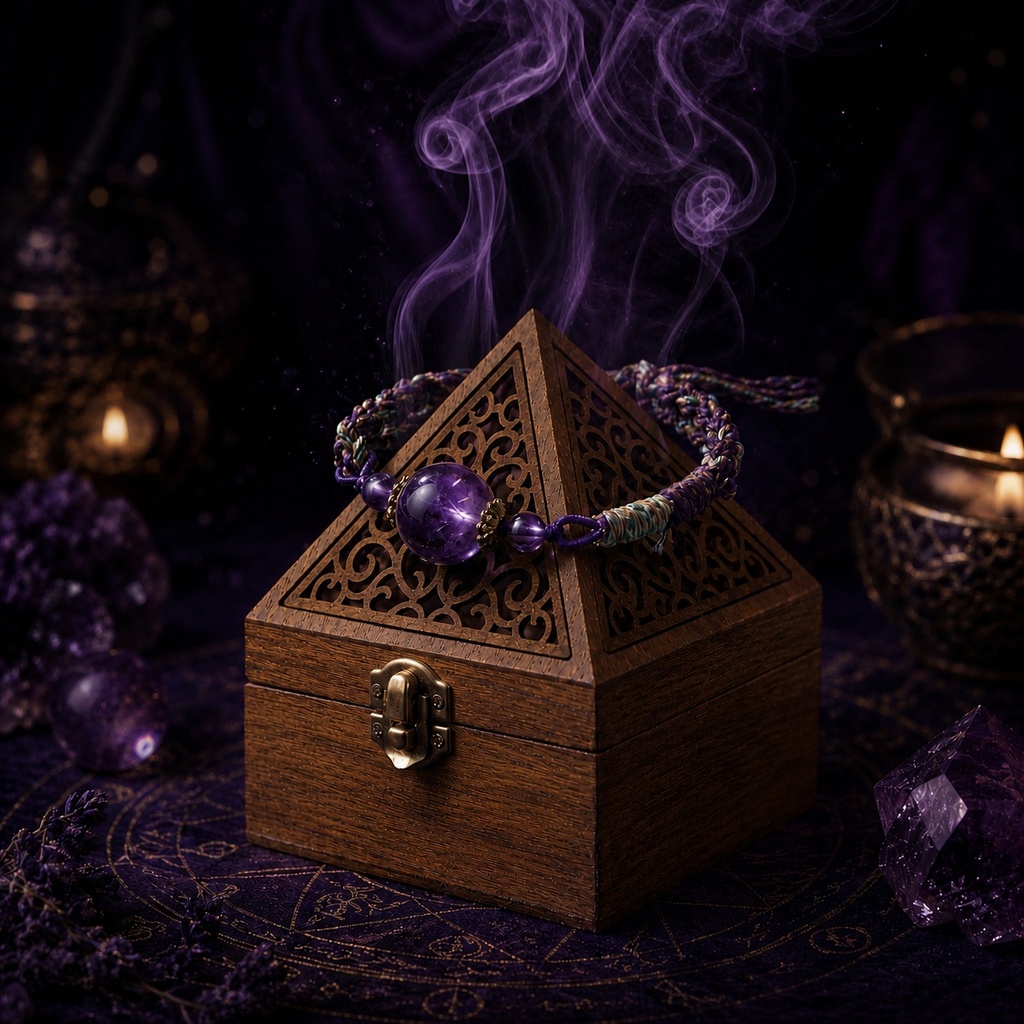
You notice it before you can name it: a bracelet that sits a little differently on your wrist, a cord with a slight and entirely human unevenness, a stone that seems to catch the light in a way you have not seen before — because you have not, not exactly. Handcrafted jewelry carries something mass-produced pieces rarely do, which is the visible trace of a person’s hands and the small, honest variations that come from making something one at a time.
That difference is not mystical and it is not marketing. It is craft. When a bracelet is woven rather than stamped, when a cord is knotted by hand rather than sealed by a machine, when a stone is chosen rather than sorted by an algorithm, the finished piece becomes a little less like a product and a little more like a possession — something that belongs to you specifically.
If you have ever wondered why handcrafted jewelry feels more personal, the answer lives in three details: the cord, the stone, and the scale at which the piece was made. Here is what each of them actually means once the jewelry is on your body, in your day, and part of your routine.
Why Handcrafted Jewelry Feels Different the Moment You Put It On
Mass-produced jewelry is built for uniformity. Every link is identical, every surface polished to the same flat shine, every clasp interchangeable. Handcrafted jewelry is finished by eye and by hand, so edges are softened individually and surfaces keep a faint texture you feel more than see. That is why a handwoven piece often has a slight give to it, moving with your wrist instead of sitting stiffly against it.
Weight tells the story too. A hand-knotted bracelet tends to be lighter and more flexible than a chunky metal chain, and a pendant on a hand-braided cord hangs differently than one on a machine-finished chain. These are tiny things. They are also the things you notice every single time you reach for the piece.
There is also intention. When a maker sits down to weave one bracelet, that bracelet is being made for a person rather than a pallet. You can feel the difference between something designed to be sold in bulk and something designed to be worn. A piece like Return to Zero, a handwoven obsidian bracelet, is a good example: the weaving itself is part of the design, not an afterthought.
Shop the Sorvara ritual
The Quiet Craft of Braided Cords and Hand-Knotted Details
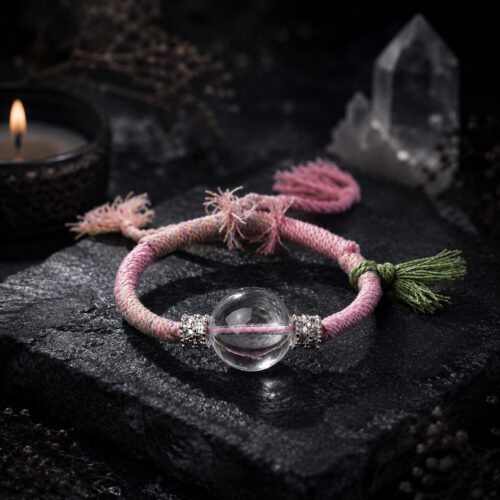
Cords are the most overlooked part of jewelry and, in many ways, the most intimate. A braided cord is made by tension — the maker’s hands keep steady pressure so the weave stays even. Small shifts in that tension create subtle variation along the length of the cord. That variation is not a flaw. It is the signature of a piece made by hand, and it is exactly what makes a handwoven crystal bracelet feel warmer than a factory chain.
What a Handwoven Bracelet Actually Tells You
A handwoven bracelet tells you how much time went into it. Knotting, braiding, and finishing take patience, and that patience stays embedded in the finished object. It also says something about durability: a well-knotted cord distributes tension evenly, which is why hand-knotted pieces often hold up beautifully with basic care.
Why Knots and Braids Age Beautifully
Braided cords soften with wear. They conform to your wrist, take on a gentle patina, and gradually stop feeling like something new and start feeling like something yours. Machine-finished pieces tend to stay exactly the same until they fail. Hand-knotted pieces evolve.
- Look at the weave. Even, consistent tension is a sign of careful handwork.
- Check the ends. Cleanly finished knots and sealed tips mean the piece was made to be worn daily.
- Feel the flexibility. A cord that bends easily will sit comfortably for hours.
Natural Stone Variation: Why No Two Pieces Look Exactly Alike
Natural stone forms over a very long time under conditions no one controls. That is why two bracelets made from the same material can look like cousins rather than twins. One rose quartz bead might be milky and pale; the next might carry a faint blush of pink. Obsidian may be glossy and black or show a quiet sheen. Amethyst can range from soft lavender to deep violet.
Inclusions, color shifts, and tiny internal patterns are not defects. They are the record of how the stone formed, and they are the reason natural stone variation is one of the most-loved qualities of handcrafted jewelry. A machine can match color perfectly. It cannot replicate the specific stone that ended up in your bracelet.
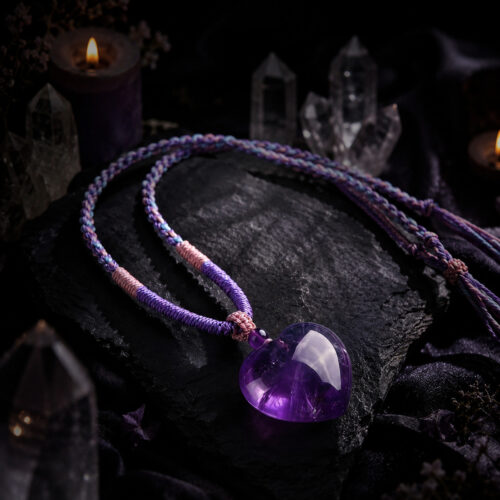
Many people choose stones for their traditional associations as much as their appearance. Clear quartz is often chosen for clarity and simplicity, amethyst is traditionally associated with calm evenings, and obsidian is frequently kept as a reminder of steadying and starting over. These are symbolic meanings, not promises — the real value is that the stone serves as a small, tangible reminder of whatever you want to keep in mind. A piece like Violet Heart, a hand-woven knotted violet heart crystal bracelet, works that way for many wearers: the color and the shape do the remembering for you.
Small-Batch Jewelry and the Feeling of Being One of a Few
Small-batch making changes the relationship between a person and a piece of jewelry. When a design is produced in limited numbers, the maker can choose stones individually, adjust a cord’s length, and notice details a large production line cannot. Nothing is identical, and that is the point.
There is a quiet pleasure in wearing something that was not made in the tens of thousands. It is the same reason people love a hand-thrown mug or a hand-bound notebook: the object carries the shape of a decision. Small-batch jewelry often means stones are selected in small lots, so the exact shade you receive may never be repeated in quite the same way.
That quality also makes handcrafted pieces unusually good gifts. A set like The Story in Three Parts feels considered rather than purchased — the kind of gift that says you thought about the person, not just the occasion.
Choosing a Handcrafted Piece That Feels Like Yours
Because handcrafted jewelry varies, choosing well is less about following a trend and more about noticing what you actually reach for. Three questions help.
Start With the Color You Keep Coming Back To
Ignore what is trending for a moment. Look at your closet, your home, the photos you save. Most people return to two or three colors again and again — soft blush, deep blue, warm gold, or violet. Starting there means the piece will work with what you already wear. A rose-toned bracelet like Rose Memory or a warm neutral like Slow Sunday tends to layer easily, while an expressive piece like Aurora Wild makes a better statement on its own.
Let the Weight and Drape Decide
If you type at a desk all day, a lighter handwoven bracelet will feel better than a heavy chain. If you like layering, a choker plus a pendant plus a bracelet gives you more range. If you want one piece that does everything, a simple handwoven bracelet or a single symbolic pendant is usually the answer.
- For everyday: one handwoven bracelet you never take off.
- For layering: a choker with a pendant on a hand-braided cord.
- For gifting: a symbolic pendant such as Inner Cosmos.
A Small Ritual That Makes a Piece Feel Personal
Handcrafted jewelry becomes more personal through repetition. The simplest way to build that connection is a short daily ritual — a moment to put the piece on, or take it off, with attention.
In the morning, that might be thirty seconds at your dresser: you fasten your bracelet, set an intention for the day, and leave it at that. In the evening, it might be the reverse — removing your jewelry, setting it in a small dish, and lighting a stick of incense while the day winds down. If you like a warm, quiet atmosphere, a ceramic burner such as Still Fire makes the ritual feel deliberate without being elaborate, and a wooden holder like the Pyramid Pine Wood Incense Burner keeps the corner of a desk or nightstand looking calm.
The jewelry does not need to do anything except be there. What matters is the pause: a few seconds when you are not rushing, and a small object that reminds you of who you are trying to be that day.
Caring for Handcrafted Jewelry So It Stays Yours for Years
Handcrafted pieces are made to be worn, not preserved in a box. A little care goes a long way.
- Keep cords dry. Remove bracelets and chokers before swimming, showering, or heavy cleaning.
- Avoid perfume and lotion on cords. Apply skincare first, then put your jewelry on.
- Store pieces separately. A soft pouch keeps stones from scratching each other.
- Wipe stones gently. A dry, soft cloth is usually all that is needed.
- Rotate what you wear. Giving a piece a rest day keeps the cord’s tension healthy.
Over time, you may notice the cord softening and the stones settling into a slightly deeper tone. That is not wear and tear in a negative sense — it is the piece becoming yours, the way a favorite pair of jeans or a well-used mug becomes yours.
When a Piece Stops Feeling Like a Purchase
There is a point with handcrafted jewelry where the object stops being an item you bought and starts being an item you have. It happens slowly: after a few dozen mornings of fastening the same clasp, after a cord has molded to your wrist, after you have looked down at a stone during a hard afternoon and remembered what you were trying to hold onto.
That is the quiet advantage of braided cords, natural stone variation, and small-batch making. None of them are loud. All of them make a piece harder to replace with something generic.
If you are looking for a piece that feels like it was made with a person in mind, start with something simple and wearable: a handwoven bracelet like Return to Zero or Violet Hour, or a symbolic pendant like Dream Cord that you can layer with what you already own. Wear it daily. Let it soften. Let it become the one you reach for without thinking.