Let’s acknowledge something upfront.
You might be someone who finds the idea of crystal energy completely plausible — you’ve felt something when you hold certain stones, and that’s enough for you. Or you might be someone who finds it slightly ridiculous, but you’re drawn to crystals anyway, and you’d rather not examine that too closely. Or you might be somewhere in the middle: genuinely curious, somewhat skeptical, and hoping that whoever wrote this isn’t going to try to sell you on anything too strange.
All three of those people are welcome here. And this is what we’re going to tell all of them:
You don’t have to believe anything. You just have to notice.
First: What Is Crystal Energy, Really?
The honest answer is that no one knows exactly — and that’s not a dodge. It’s actually the most interesting part.
What we do know is this: crystals are not inert objects. They are highly ordered structures — their atoms arranged in precise repeating patterns that form over millions of years under extreme conditions of heat and pressure. This structural regularity is why crystals are used in everything from watches (quartz oscillators) to computers (silicon chips) to medical ultrasound equipment (piezoelectric crystals). The idea that these structures might interact with the bioelectrical fields of living bodies is not scientifically absurd — it just hasn’t been studied with the rigor that would satisfy a peer-reviewed journal.
In the meantime, humans across virtually every culture in recorded history have been picking up crystals and feeling something. That consistency of experience, across so many different times and places and belief systems, is at least worth being curious about.
But here is the simpler version, the one that doesn’t require any particular position on the physics:
Crystals are objects that carry meaning. The meaning is partly inherent — in the color, the weight, the texture, the geological story. And partly it is given — by you, by the intention you bring, by the ritual you build around them. Both kinds of meaning are real. Both kinds work.
The Language of Crystal Energy
Crystal practitioners use a vocabulary that can feel a bit much if you’re new to it. Let’s translate the most common terms into plain language.
Vibration / Frequency You’ll see this a lot. It sounds technical but it’s being used poetically. “High vibration” essentially means “associated with expansion, openness, and clarity.” “Low vibration” means “associated with heaviness, contraction, or stagnation.” When someone says a crystal raises your vibration, they mean it tends to shift your mood or energy in the direction of lightness or clarity.
Energy centers / Chakras A system from ancient Indian tradition that maps the body into seven primary energy centers, each associated with different emotional and physical states. Many crystal practitioners match specific stones to specific chakras — amethyst to the crown (clarity and connection), rose quartz to the heart (love and compassion), citrine to the solar plexus (confidence and abundance). You don’t have to adopt the entire framework to find this mapping useful.
Intention This is the word that does the most work in crystal practice. Setting an intention means deciding — consciously, specifically — what you want to invite or embody. When you hold a crystal and set an intention, you are essentially using the object as a focal point for a kind of mental commitment. The crystal doesn’t make the intention real. Your attention does. The crystal just gives your attention somewhere to land.
Programming a crystal This just means dedicating a crystal to a specific intention or purpose. You “program” it by holding it, saying or thinking your intention clearly, and then consistently returning to that intention when you use the crystal.
The Eight Crystals You’ll Meet First (And What They Actually Carry)
We’re going to skip the comprehensive encyclopedia and focus on the crystals you’re most likely to encounter — because information overload is the enemy of any good beginning.
Amethyst — For the mind that won’t quiet down
Amethyst is the one most people reach for first, and there’s a reason. Its deep purple color is associated with the space between waking and sleep — that liminal zone where your thinking slows down and something quieter becomes audible.
If you find yourself unable to rest, running on anxiety, or struggling to access your own intuition beneath the noise of daily life, amethyst is often described as the stone that makes the quiet more accessible. Not by silencing anything — but by reminding you it’s there.
Carry it when: You need to slow down and actually think, rather than react.
Rose Quartz — For the relationship with yourself
People assume rose quartz is about romantic love, and it can be. But its deeper association is with self-regard — the particular kind of warmth you extend to yourself when you’re exhausted and imperfect and still trying.
It is the stone for anyone who would never say to a friend what they regularly say to themselves. It doesn’t have a simple fix for that. But it tends to soften things.
Carry it when: You’re being hard on yourself in a way you wouldn’t be with anyone you love.
Clear Quartz — The blank page
Clear quartz is often called the master crystal, and not because it does everything — but because it amplifies whatever intention you bring to it. It doesn’t have a fixed energy of its own. It takes yours and magnifies it.
This makes it ideal for people who want to work with intention deliberately. It’s also the crystal people tend to love without being able to explain why — because it reflects something of you back at you, and that’s always interesting.
Carry it when: You have something specific you want to focus on or invite, and you want a crystal that will hold that intention cleanly.
Citrine — For the mornings you can’t get started
Citrine is yellow and warm and it carries the energy of that: solar, expansive, gently energizing. It’s associated with abundance and optimism — not the relentless positivity of affirmation culture, but the more grounded understanding that your perspective shapes your experience, and sometimes a small shift is enough.
It’s the crystal equivalent of opening the curtains.
Carry it when: You’re feeling contracted, low, or stuck — and need a nudge rather than a push.
Black Obsidian — For when you need to hold your ground
Obsidian is volcanic glass — formed when lava meets water and cools almost instantly. There is something about that origin story that feels right for what it carries: transformation that happened fast, under pressure, resulting in something solid and sharp and clear.
It’s associated with protection and with boundary-setting — the capacity to say “this is where I end and other things begin.” For people who absorb everyone else’s energy too readily, obsidian can be a useful reminder of their own edges.
Carry it when: You’re walking into something difficult, or someone else’s chaos is becoming yours.
Green Aventurine — For the leap you keep not taking
Green aventurine is sometimes called the stone of opportunity — not because it conjures luck from nowhere, but because it’s associated with the particular kind of courage that allows you to take action when you don’t have a guarantee. The courage of beginning.
It’s a gentle stone. It doesn’t push. It more quietly asks: what would you do if you believed it might actually work?
Carry it when: You’re standing at the edge of something and you can’t quite jump.
Labradorite — For the part of you that nobody else sees
Labradorite looks like a grey stone. And then you turn it in the light and there’s an entire iridescent world inside it — blue, green, gold, violet — all of it hidden unless you look at exactly the right angle.
This is not an accident of nature. It is the stone’s nature. And it speaks to something real: the most interesting parts of people are usually the ones that require a particular kind of light and attention to see.
Labradorite is associated with magic, with inner life, with the recognition that you are more than what is immediately visible.
Carry it when: You’ve been feeling unseen, or you want a reminder that your depths are real.
Moonstone — For the woman who is changing
Moonstone is for transitions. It is for the version of yourself you are in the middle of becoming — the one that doesn’t quite fit the old container and hasn’t yet found the new one.
Like the moon, it doesn’t apologize for changing. It just moves through its phases with a kind of inevitability that, if you can get quiet enough to notice, is actually reassuring. You are supposed to be changing. This is not a problem. This is the whole point.
Carry it when: You’re between versions of yourself and need something that understands that.
How to Choose Your First Crystal
There are two methods, and both are right.
The intuitive method: Go to where the crystals are — a shop, a market, a good photograph — and notice what you’re drawn to. Not what you think you should want. What you actually want. The one you keep coming back to. That’s your crystal.
The intentional method: Decide what you most need right now. Not what you wish you needed, or what looks most impressive. What is actually most present for you — anxiety, transition, low energy, the need to be kinder to yourself? Then find the stone that matches that. Trust the match.
Either way, the crystal you choose is the right one. Because the real work is yours.
One Last Thing
You don’t need a collection. You don’t need a ritual that takes an hour. You don’t need to understand the geology or the chakras or the history.
You need one stone. A few minutes. And the willingness to use a beautiful object as a reason to pay attention to what’s happening inside you.
That’s all crystal practice has ever been. The rest is decoration.
Start somewhere. Start small. Notice what happens.
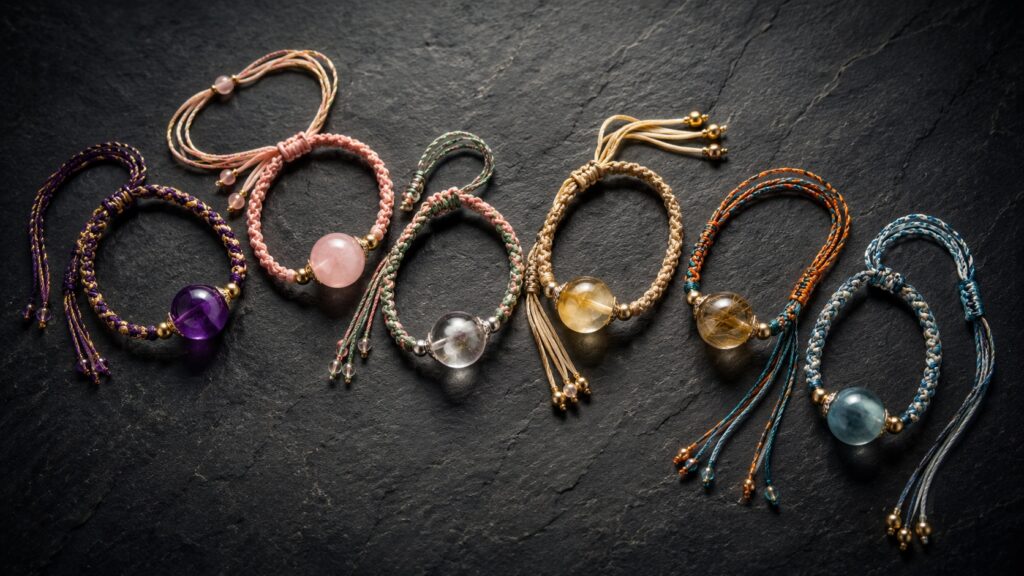
All Sorvara pieces are handcrafted with natural crystals selected for their quality and character. If you’re not sure where to start, our crystal quiz takes about sixty seconds — and usually knows.